 Civil Resilience
Power and light
A torch rather than candles, a charged power bank, the number to report a power cut, and what Be Ready says about solar batteries and load block letters.
- Essentials
Be Ready says the UK has a resilient electricity system and most power cuts are short and local. Wider and longer outages can happen, and could last several days. Without power, gas ovens, boilers, heat pumps and the home internet stop working, the mobile phone may stop if the local mast is affected, and mains water can be disrupted.
Light
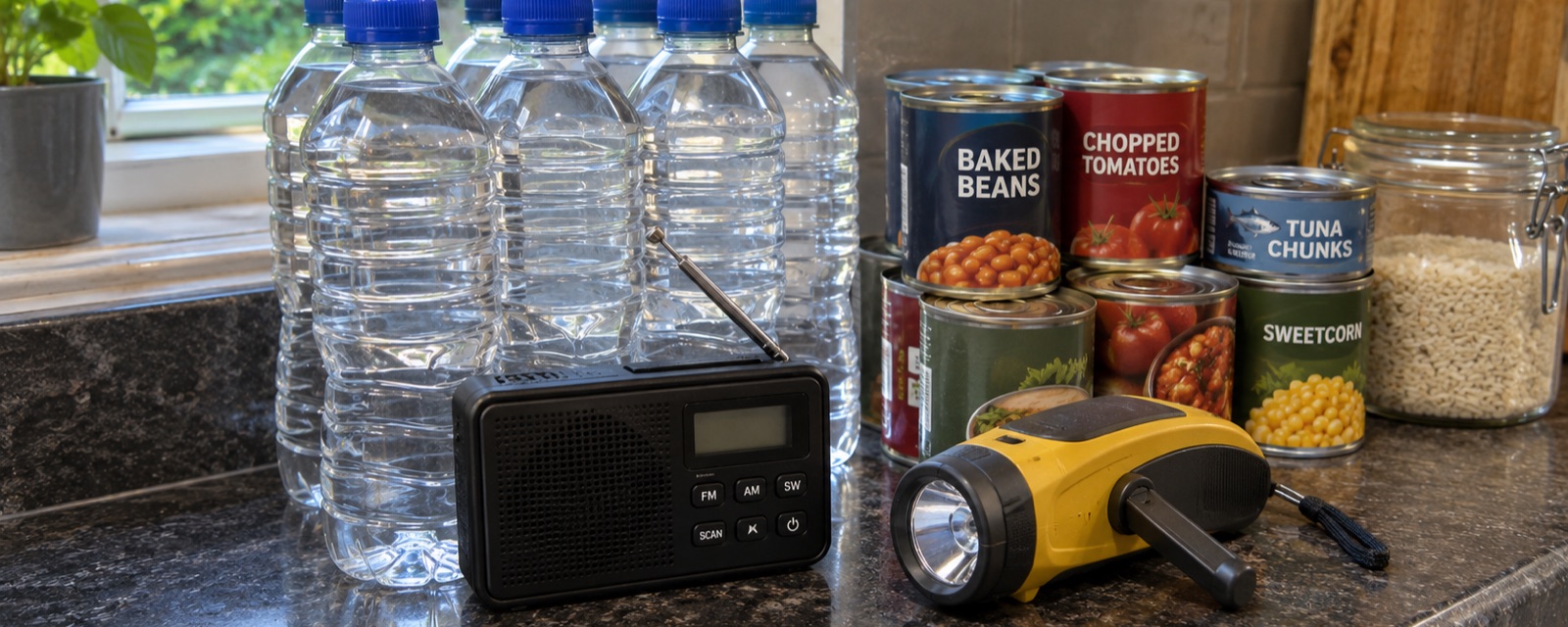
Keep a battery or wind-up torch at home, with spare batteries. Be Ready says torches are safer than candles. It also advises against relying on the torch on a mobile phone, because it drains the phone's battery more quickly. Keep the torch somewhere easy to find in the dark, together with the radio and any written notes.
Keeping devices going
The checklist asks for a charged power bank, to charge phones or compatible medical devices. When a storm is forecast, Be Ready's storms page says to charge mobile phones, power banks and any back-up batteries for medical equipment in case of a power cut. During an outage, use devices sparingly to save battery until you can charge again.
Reporting a power cut
In England, Scotland and Wales, call 105. It is free and available at any time. Be Ready asks you to write the number down on paper and to save it in your phone, because you may have no internet during a power cut. Northern Ireland has its own number, listed on the Be Ready power cuts page. You can also report a power cut and track updates on your network operator's website through https://www.powercut105.com/en/.
If you have a life-threatening emergency during a power cut and no working landline, Be Ready says to try 999 from a mobile. Emergency calls automatically roam onto any available network, so you may pick up signal from a nearby unaffected area.
Solar panels and batteries
Be Ready notes that some solar panel and battery storage installations with power back-up capability can continue to provide power during a cut, if they are designed and configured to operate independently of the grid. That depends on the installation, so check with the installer.
Load block letters
In the unlikely event of a national energy shortage, emergency power cuts could be scheduled area by area on a rotation. Each area in Great Britain has a load block letter, and an area would be disconnected for around three hours at a time. You can find your letter by entering your postcode at powercut105.com, and some electricity bills show it.
During a power cut
Be Ready's during-a-cut advice: turn off items such as irons, ovens, electric fires and fryers; unplug the TV and PC, which can be damaged by a surge when power returns; keep away from power lines, because electricity at high voltage can jump gaps without warning; and keep fridge and freezer doors closed. Check on neighbours and pass on any information you have about when power is expected back. The keeping warm and staying in touch pages cover heat and communications.
Medical equipment
If anyone in the household uses medical equipment that needs power, Be Ready asks you to make a plan now with the care provider or clinical team: what action to take and who to contact. The Priority Services Register at thepsr.co.uk gives priority support during power cuts, support for medical equipment that needs electricity, and advance notice of planned work. See the Priority Services Register.
Checklist
- A battery or wind-up torch, with spare batteries
- Torches rather than candles
- A charged power bank, for phones or compatible medical devices
- The number 105 written down, to report a power cut in England, Scotland and Wales
- A battery or wind-up radio, and the frequencies of the stations you use
- Torch, radio and written notes kept together where you can find them in the dark
- Your load block letter, from powercut105.com or your electricity bill
- Phones, power banks and medical equipment batteries charged when a storm is forecast
Related pages
Sources
- beready.campaign.gov.uk/be-ready-for-emergencies
- beready.campaign.gov.uk/wp-content/uploads/sites/252/2026/10/Be-Ready-Checklist_English.pdf
- beready.campaign.gov.uk/be-informed-about-hazards/power-cuts
- beready.campaign.gov.uk/be-informed-about-hazards/storms
- beready.campaign.gov.uk/be-informed-about-hazards/phone-broadband-outages
- www.thepsr.co.uk
Last updated 29 October 2026. Reviewed 29 October 2026